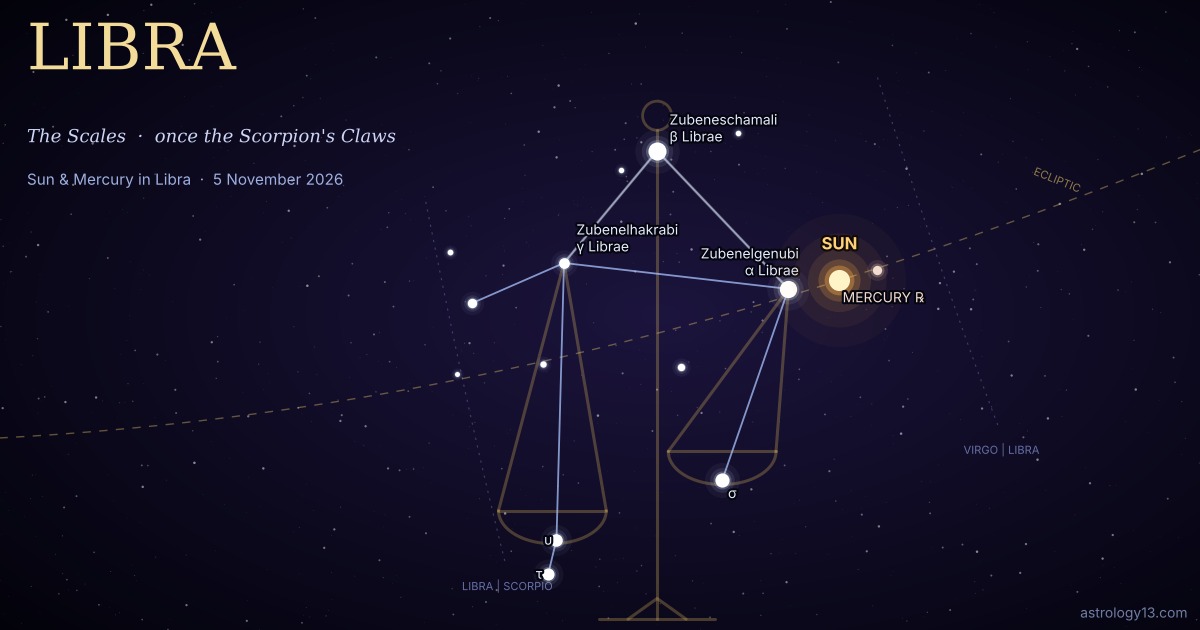
Right now the Sun is passing in front of the stars of Libra, the only figure in the zodiac that is an object rather than a living being. In 13-sign astrology, which follows the real constellations, the Sun stays in Libra (October 31 – November 22) before moving on to Scorpio (November 23 – November 29). Libra is faint and easy to overlook, yet it has one of the most interesting stories in the sky.
From Claws to Scales
For the ancient Greeks, these stars did not form a constellation of their own. They were the Chelae, the outstretched claws of the great Scorpion next door. Even in Ptolemy's Almagest, the standard star catalogue of antiquity, the region still appears under the name "the Claws".
The idea of a balance is older still. Babylonian astronomers already linked this part of the sky with scales, and the Romans later revived the image and made Libra a firm member of the zodiac. In their version, the scales often belong to the neighbouring maiden Virgo, pictured as Astraea, the goddess of justice.
Star Names That Remember the Past
The old claws survive in the names of Libra's two brightest stars. Zubenelgenubi (Alpha Librae) means "the southern claw", and Zubeneschamali (Beta Librae) means "the northern claw". Both come from Arabic and preserve the time when Libra was part of Scorpius.
Zubenelgenubi lies about 77 light-years from us. Binoculars show it as a wide pair of stars. It also sits very close to the ecliptic, the path of the Sun, so the Moon and the planets often pass near it. Zubeneschamali is the constellation's brightest star, roughly 185 light-years away. Some observers have described it as having a greenish tint, although most people see it as blue-white.
Why a Balance?
The usual explanation involves the equinoxes. Nearly three thousand years ago, the autumn equinox, when day and night are equal in length, fell among the stars of Libra. A pair of scales, holding light and darkness in perfect balance, made a fitting symbol.
Precession has moved things on since then. Earth's axis wobbles slowly, like a spinning top, and over the centuries the equinox points have drifted westward along the zodiac. Today the autumn equinox lies in Virgo, and the Sun reaches Libra a full month later than it did in antiquity. That drift is one of the main reasons the dates of the 13 signs differ so much from the familiar tropical calendar.
Libra in the Sky This Month
You won't see Libra in November, because the Sun is standing right in front of it. This month the constellation is also hosting Mercury, which passed between Earth and the Sun on November 4 and is currently retrograde in Libra. Look for the faint Scales in the evening sky of late spring and early summer, low in the south for observers in the Northern Hemisphere, between bright Spica in Virgo and red Antares in Scorpius.
If you were born between October 31 and November 22, this quiet, balanced patch of sky is your own. The book Astrology of the 13 Signs of the Zodiac explores what that means for your character and your path, using the stars as they really are.
Vasilis Kanatas
Delphi, November 2026