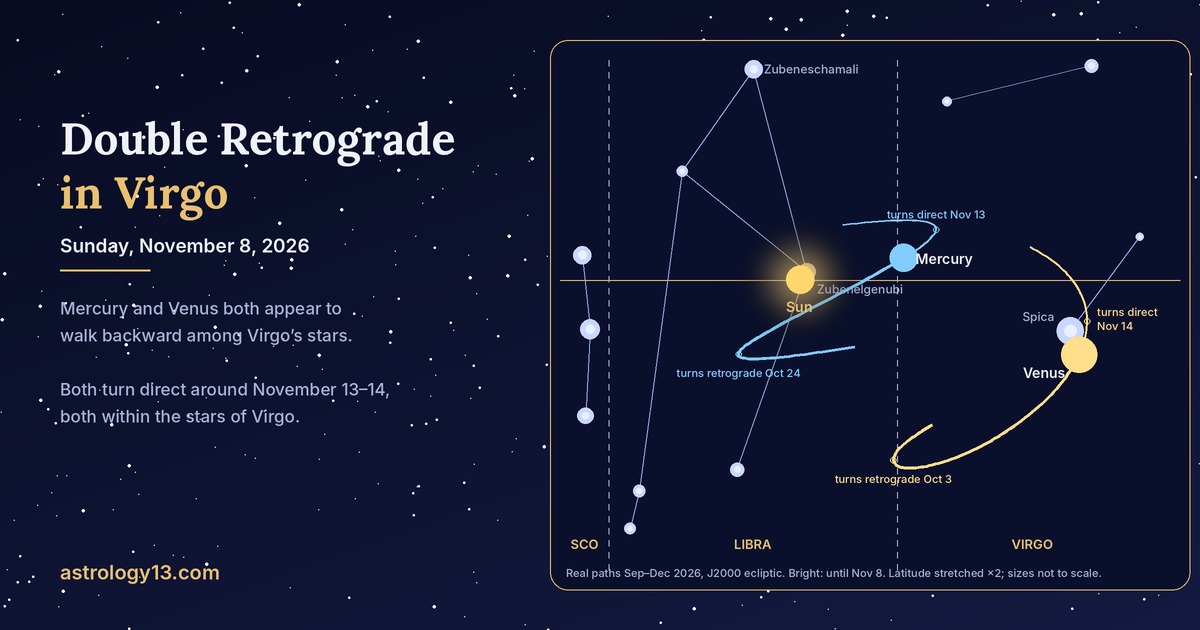
For a few days this November, two of our closest neighbours are doing something that has fascinated sky-watchers for thousands of years. Both Mercury and Venus appear to move backward against the stars, and in the real sky they are doing it in the same constellation: Virgo.
What retrograde motion really is
No planet ever stops or reverses in its orbit. Retrograde motion is an effect of perspective. Mercury and Venus orbit the Sun inside Earth's orbit and move faster than we do. When one of them passes between the Earth and the Sun, an alignment called inferior conjunction, it overtakes us on the "inside lane". For a few weeks around that moment, its position against the distant stars appears to slide westward instead of eastward.
Venus reached inferior conjunction around October 23–24, 2026, and Mercury on November 4. That is why both are retrograde at the same time. Venus has been moving backward since October 3, and Mercury since October 24. Both turn direct again around November 13–14, 2026.
Where it is happening in the real sky
Tropical astrology describes this retrograde season in Scorpio and Libra. The planets themselves tell a different story. Venus began its retrograde at the very edge of Libra and Virgo and has spent almost all of it in Virgo. It will turn direct close to Spica, the bright "ear of wheat" in the Maiden's hand, where it will appear to stand still for a few days.
Mercury began its backward loop in Libra, then slipped back into Virgo around November 7–8. It, too, will turn direct among Virgo's stars. So in the 13-sign zodiac, this is a Virgo story. Virgo (September 17 – October 30) is the constellation of careful work, review and harvest. Libra (October 31 – November 22), where the Sun is shining right now, is the constellation of balance.
How to see it
You can follow part of this dance yourself. Venus is already a brilliant morning star, low in the east before sunrise. As the days pass it climbs higher and moves slowly past Spica. Mercury is harder to see, but in the second half of November it should rise ahead of the Sun in the dawn sky. Look a little below and to the left of Venus, and be sure to stop before the Sun comes up. Never look at the Sun directly.
A season for second looks
Many astrologers see a retrograde as a time to revisit, repair and reconsider. With both Mercury and Venus retracing their steps in Virgo, the theme feels especially fitting. It is a good time to reread, revise and value the small details. In Astrology of the 13 Signs of the Zodiac, each constellation is read on the sky we can actually see, and this double retrograde is a lovely example of why that matters.
Curious which constellation the Sun was really in when you were born? Find your true zodiac sign and see the sky as it truly was.
Vasilis Kanatas, Delphi, November 2026