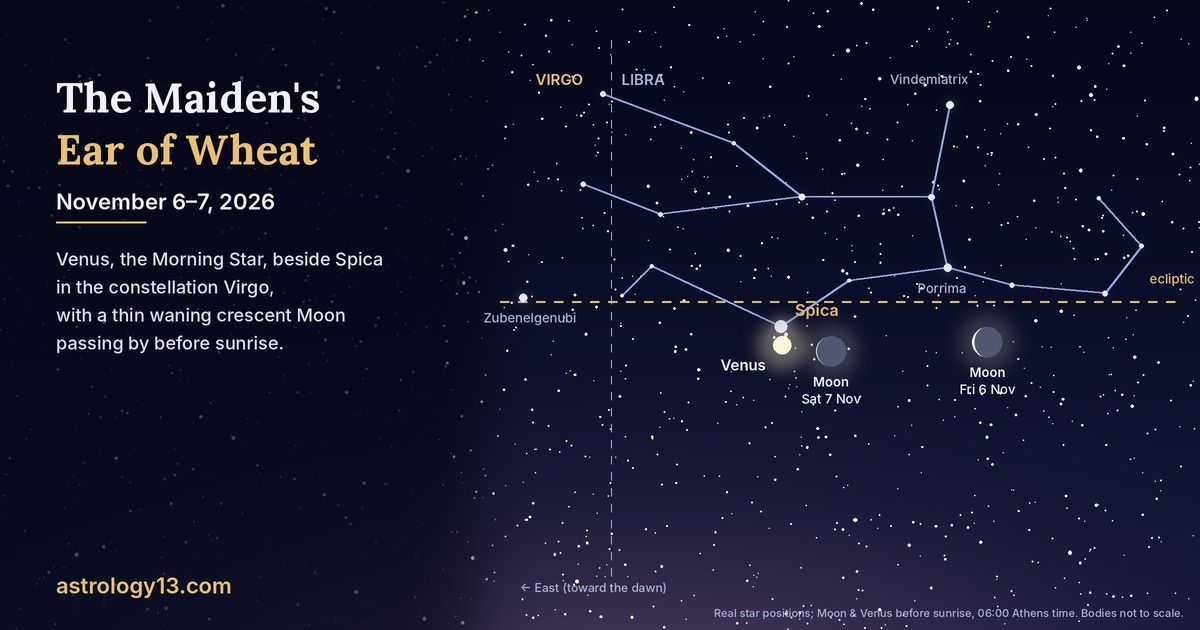
This weekend the dawn sky offers one of the loveliest sights of the autumn. Low in the east-southeast before sunrise, Venus, the brilliant Morning Star, is shining right next to Spica, the brightest star of Virgo. On Saturday, November 7, a very thin crescent Moon joins them, completing a delicate trio against the stars of the Maiden.
A Gathering in the Real Constellation of Virgo
In the 13-sign zodiac, which follows the real constellations, Venus and the Moon are both in Virgo (September 17 – October 30) this weekend, even though the Sun itself has already moved on to Libra (October 31 – November 22). Venus is retrograde at the moment, slowly drifting westward. It turns direct around mid-November and stays close to Spica for the rest of the month.
On Friday morning, November 6, the crescent Moon, about 8% lit, stands higher up and to the right of Venus. By Saturday morning it has slipped down to just a few degrees from the planet and the star, only about 4–5% illuminated. Look about 45 minutes before sunrise, with a clear view of the horizon. Venus is unmistakable; binoculars will help you catch the Moon and Spica in the brightening twilight. The next Venus, Moon and Spica gathering this close will not happen until 2034.
Who Is the Maiden?
Virgo is the largest constellation of the zodiac and the second-largest in the whole sky. The Greeks saw in it several goddesses. For the poet Aratus, she was Dike, or Astraea, the goddess of justice, who lived among people in the Golden Age. As humanity grew greedy and violent, she withdrew to the mountains and finally rose to the sky, where she still shines beside the Scales of Libra.
Others saw her as Demeter, the goddess of grain and harvest, or her daughter Persephone. That is why the Maiden is often pictured holding an ear of wheat, and the name Spica means exactly that: "the ear of grain" in Latin. In ancient times, the Sun's passage through Virgo coincided with the harvest.
Spica and the Discovery of Precession
Spica is a remarkable star. It lies about 250 light-years away and is actually a close pair of hot blue-white stars that orbit each other in just four days, so close that they are stretched into egg shapes.
It also holds a special place in the history of astrology. Around 130 BC, the Greek astronomer Hipparchus compared his own measurements of Spica with those made about 150 years earlier by Timocharis. He noticed that the star's position relative to the autumn equinox had shifted by about two degrees. This was the discovery of precession, the slow wobble of the Earth's axis that, over the centuries, has moved the signs of the tropical zodiac away from the constellations that gave them their names. It is the very reason that 13-sign astrology exists: it follows the stars, not the drifting calendar.
Look Up, Then Look Within
When you see Venus and the thin Moon beside the Maiden's ear of wheat this weekend, remember that you are looking at the same star that revealed the great turning of the heavens to Hipparchus. Curious which constellation the Sun was really in when you were born? Try our Find Your True Zodiac Sign calculator, and discover more about the real sky in the book Astrology of the 13 Signs of the Zodiac.
Vasilis Kanatas, Delphi, November 2026