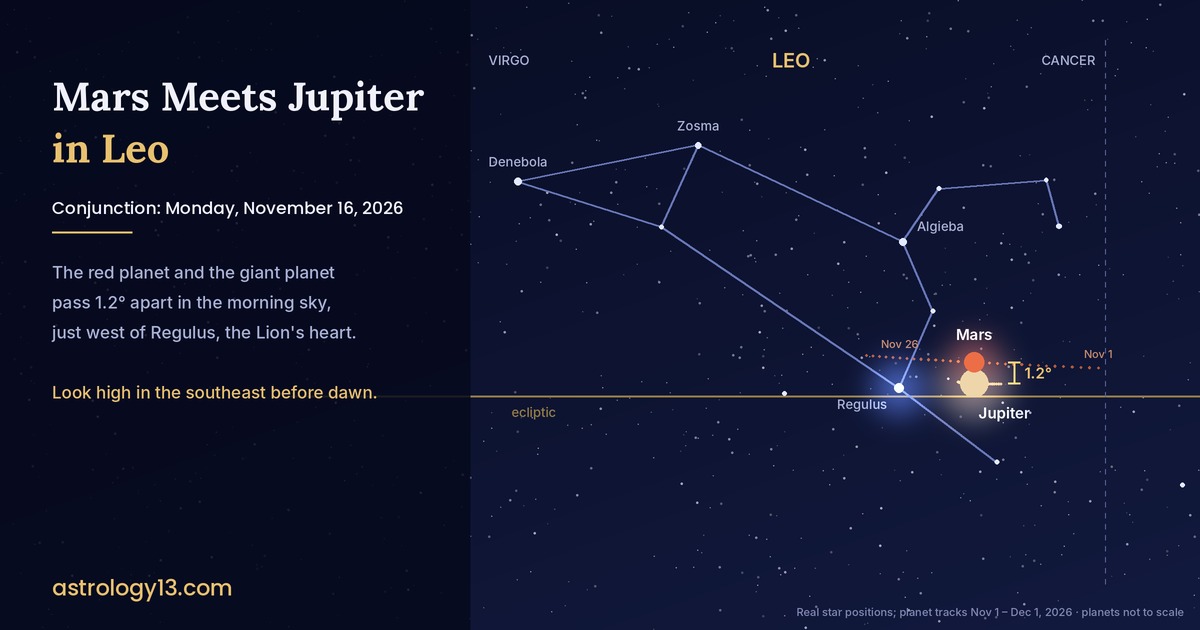
Set your alarm a little earlier this week. High in the predawn sky, two of the brightest planets are drifting toward each other among the stars of Leo, the Lion. On the morning of Monday, November 16, 2026, Mars catches up with Jupiter, and the pair pass about 1.2 degrees apart, roughly the width of two and a half full Moons. Just beside them shines Regulus, the Lion's heart, completing one of the loveliest planetary scenes of the autumn.
What is happening in the sky
Mars is much closer to us than Jupiter, so it moves faster against the background stars. Through October and November the red planet has been closing the gap morning after morning, and by November 12 the two are already less than two degrees apart. After the conjunction, Mars pulls ahead toward the east, and on November 26 it passes less than two degrees from Regulus itself. At the end of the month, around November 30 and December 1, the waning Moon joins the group, creating a beautiful gathering of Moon, Jupiter, Mars and Regulus.
The "meeting" is a line-of-sight effect. On November 16, Mars is about 1.3 astronomical units from Earth, while Jupiter is about 5.3, four times farther away. Light from Mars reaches us in about 11 minutes; light from Jupiter needs about 44. The two planets are nowhere near each other in space. From our viewpoint they simply line up in the same direction, against the stars of Leo.
How to see it
Leo climbs above the eastern horizon after midnight. By 5:30–6:00 a.m. Greek time, the pair stands high in the southeast. Jupiter is the brighter one, a steady cream-white light. Mars is fainter and clearly orange, sitting right beside it. No equipment is needed, but binoculars will show both planets in the same field of view, and a small telescope reveals Jupiter's four large moons. Lower in the east before sunrise you can also spot brilliant Venus near Spica in Virgo.
The 13-sign view
In 13-sign astrology, planets are placed in the constellations where they are actually seen, and this week's event belongs to Leo, the constellation the Sun crosses from August 11 to September 16. The myth fits the scene. Leo is the Nemean Lion, the first great challenge of Heracles, and Jupiter (Zeus) was the father of both Heracles and Ares, the god the Romans called Mars. A father and son meet in the sky, beside the heart of the Lion.
Astrologically, the conjunction combines Mars's courage and drive with Jupiter's generosity and optimism, inside the most confident constellation of the zodiac. It is a fine week for bold but warm-hearted decisions, especially for those born under Leo. As we explain in Astrology of the 13 Signs of the Zodiac, the real sky is a living calendar, and moments like this are worth stepping outside for.
Not sure which constellation the Sun was in when you were born? Find your true zodiac sign, then step outside before dawn on November 16 and look up.
Vasilis Kanatas, Delphi, November 2026