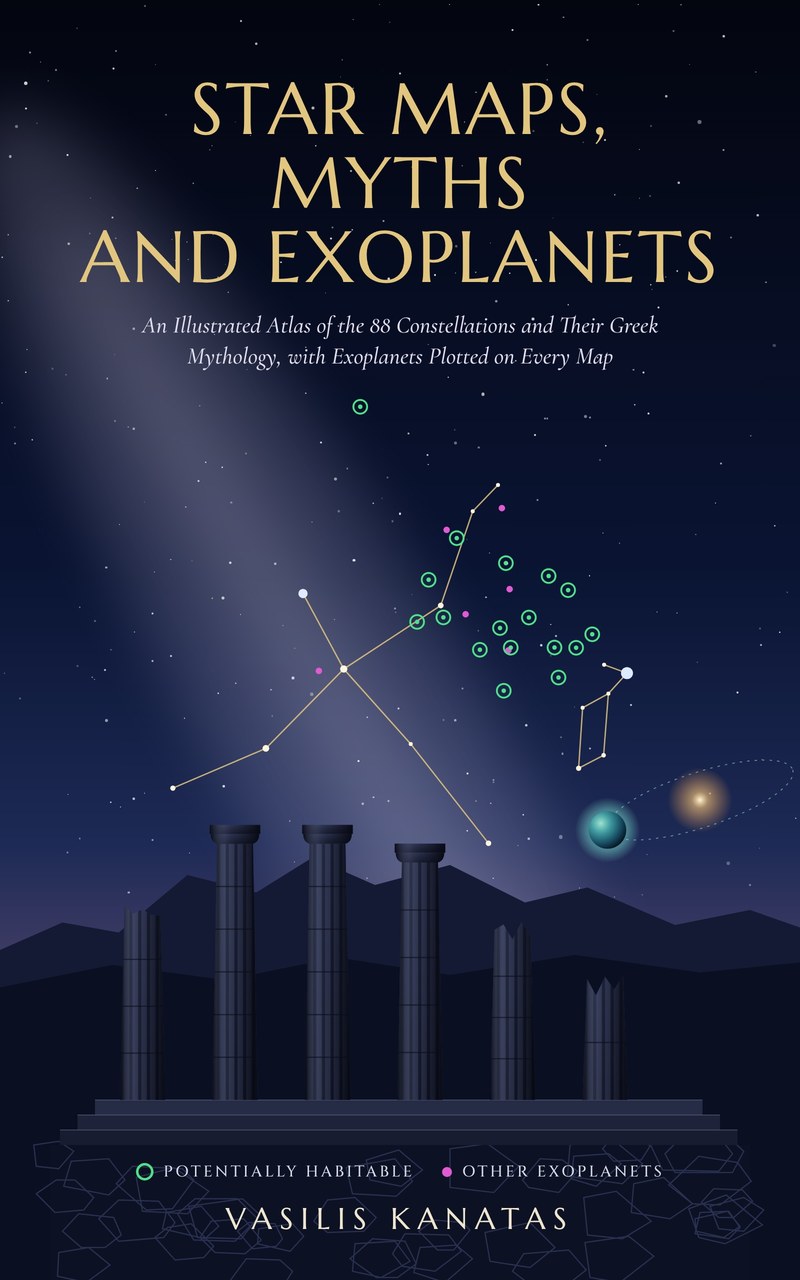
Look up at the night sky and you can read two stories at once: the myths the ancient Greeks wrote among the stars, and the new worlds astronomers have found circling those same stars. My new book, Star Maps, Myths and Exoplanets, brings the two together for the first time in a single atlas.
Get it on Amazon Kindle – $9.99 or free with Kindle+
An atlas of all 88 constellations
The book covers every one of the 88 constellations recognized by the International Astronomical Union. For each constellation you will find:
- A detailed star map with the stars that host known exoplanets marked on it – green for potentially habitable worlds, magenta for the others.
- The Greek myth behind the figure, drawn from ancient sources such as Aratus, Eratosthenes and Ptolemy.
- Its principal stars, double stars, clusters, nebulae and galaxies, with up-to-date magnitudes and distances.
- "Stars and planets in the Habitable zone": at least two exoplanets described, with a table that gives their coordinates and tells you whether their star can be seen with the naked eye, binoculars or a telescope.
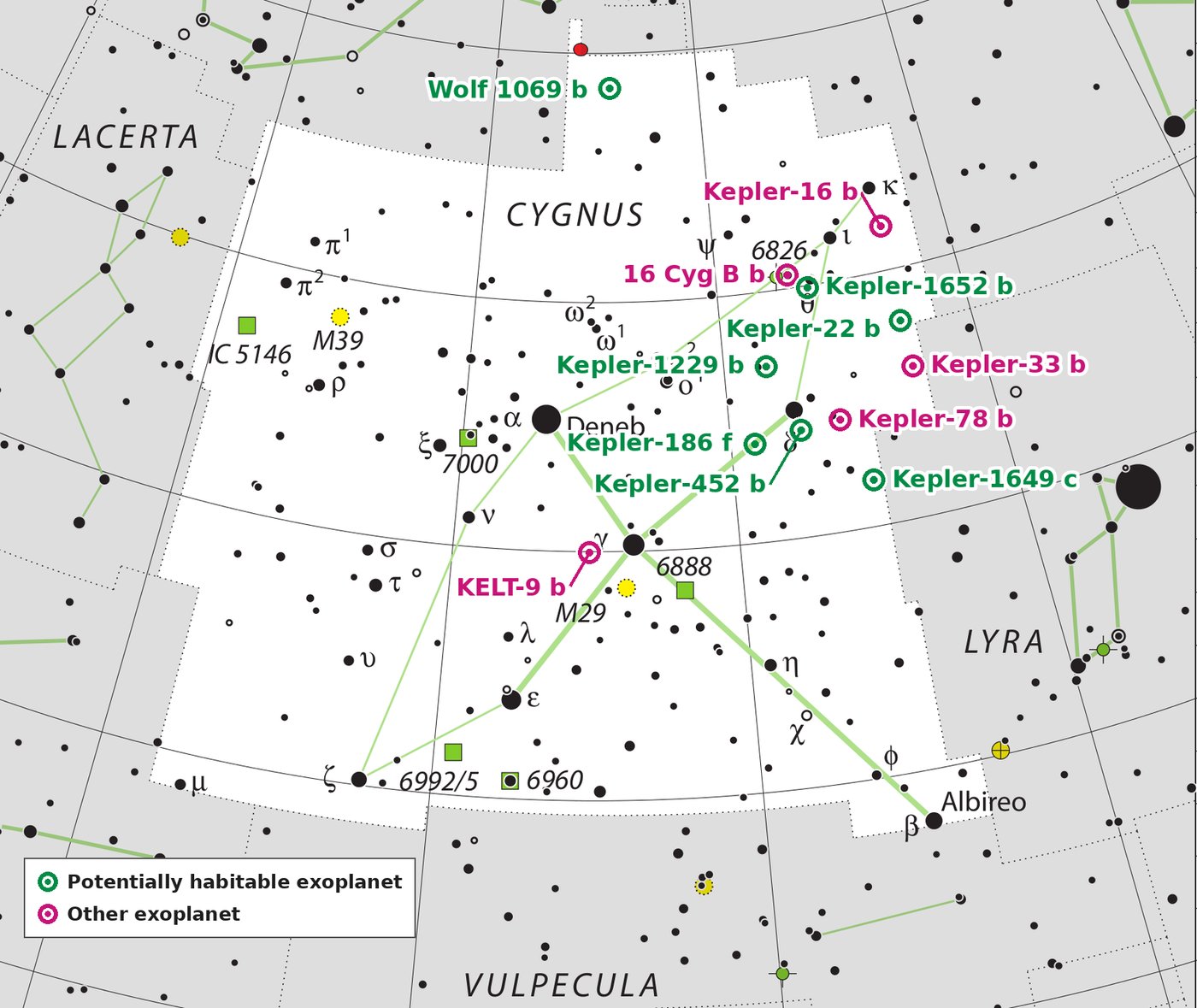
Cygnus, the Swan: the region of the sky watched for years by NASA's Kepler telescope, with its exoplanets marked on the map.
Map based on the constellation charts of the IAU and Sky & Telescope (Roger Sinnott & Rick Fienberg), CC BY 4.0; exoplanet positions added by the author.
250 exoplanets among the myths
In all, 250 exoplanets are described, chosen from the 6,464 listed in the NASA Exoplanet Archive in November 2026: the potentially habitable worlds, the nearest planets and the historic discoveries. Did you know that Greece has its own planet in the sky? In 2019 the star HAT-P-42 in the constellation of Hydra was named Lerna, and its planet Iolaus, after the nephew of Heracles who helped him defeat the Lernaean Hydra.
The introduction tells the story of how exoplanets were discovered, from the first worlds found in 1992 to NASA's TESS planet hunter, and explains the essentials of the sky: celestial coordinates, spectral types, magnitudes and distances, variable stars, star clusters, nebulae and galaxies.
The great star atlases of the past
The book is illustrated with plates from the great historical star atlases – Dürer, Bayer, Hevelius, Bevis, Stieler and the colour cards of Urania's Mirror (1824) – and with images from the Hubble Space Telescope.
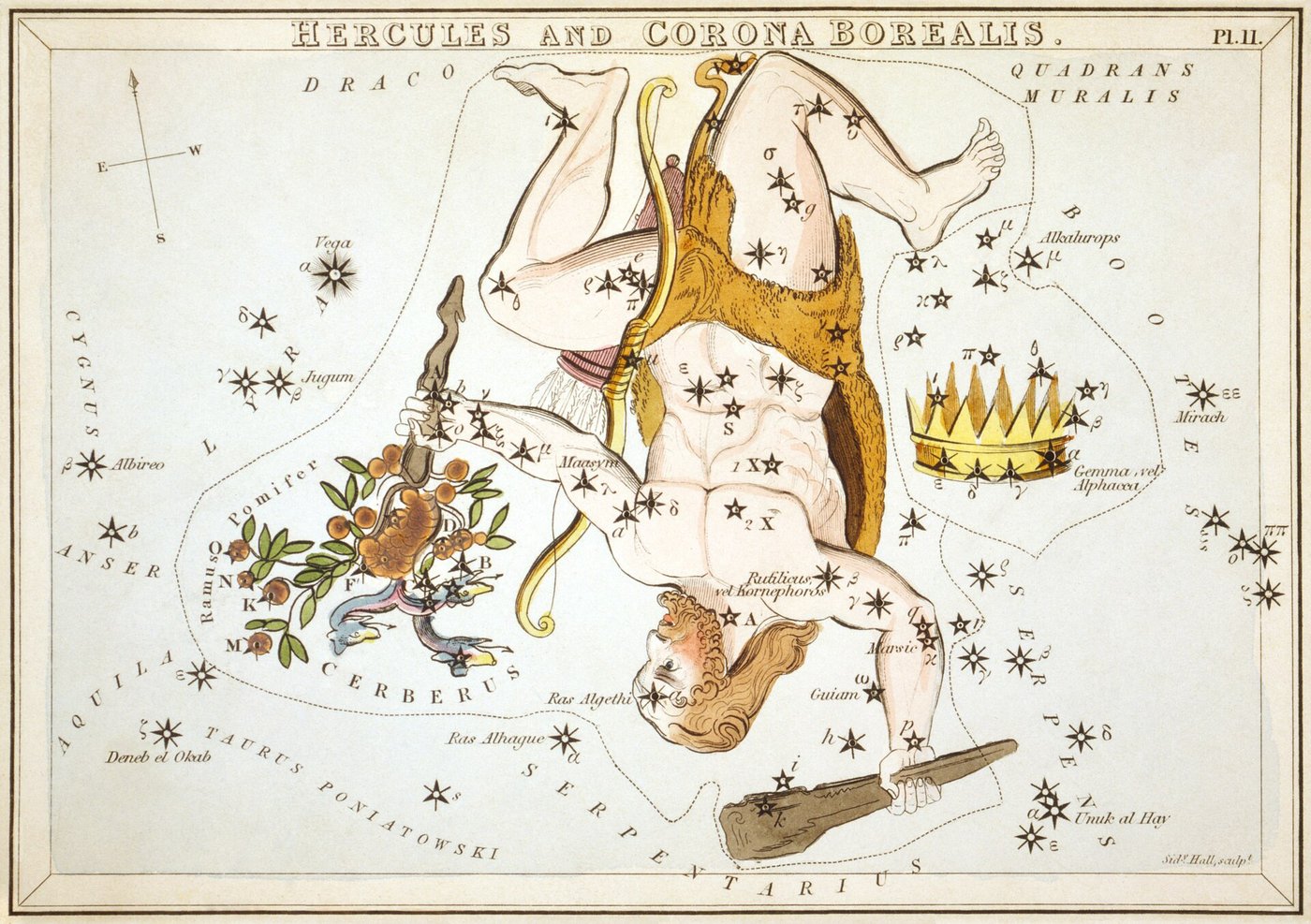
Hercules and Corona Borealis, from Urania's Mirror (1824).
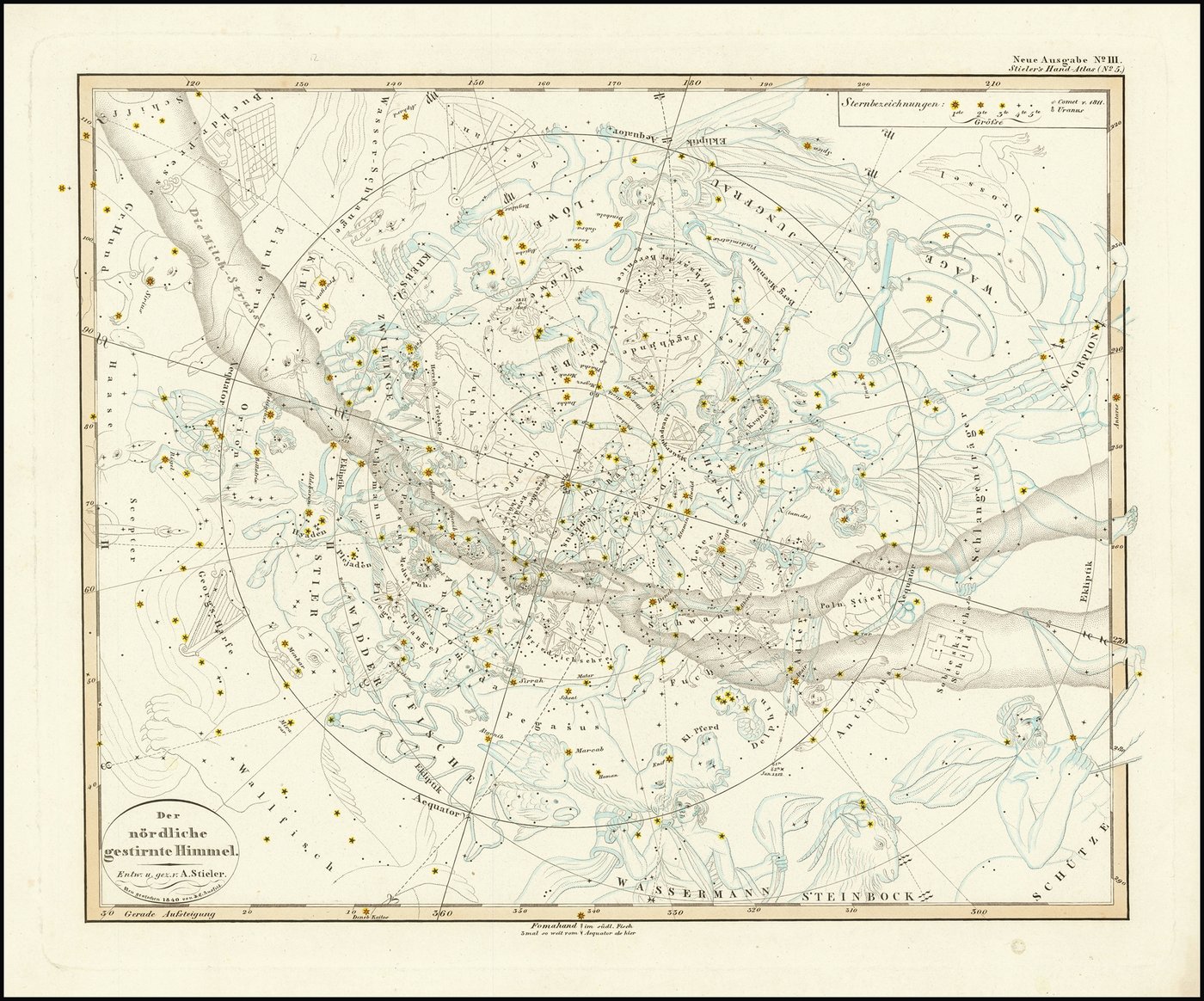
The northern sky, from Stieler's Hand-Atlas (1840).
Who is it for?
For stargazers, lovers of Greek mythology, students and anyone who has ever looked up and wondered whether someone, somewhere, is looking back.
About the author
Vasilis Kanatas was born in Delphi and grew up under the dark skies of Mount Parnassus. He studied physics, wrote his thesis on astronomy and uranography, and has observed the night sky as an amateur astronomer for about 37 years. He is a member of the Achyrostrata Amateur Astronomy Association of the Municipality of Delphi.
Read Star Maps, Myths and Exoplanets on Kindle
The paperback edition is coming soon.
Also by the author: Astrology of the 13 Signs of the Zodiac