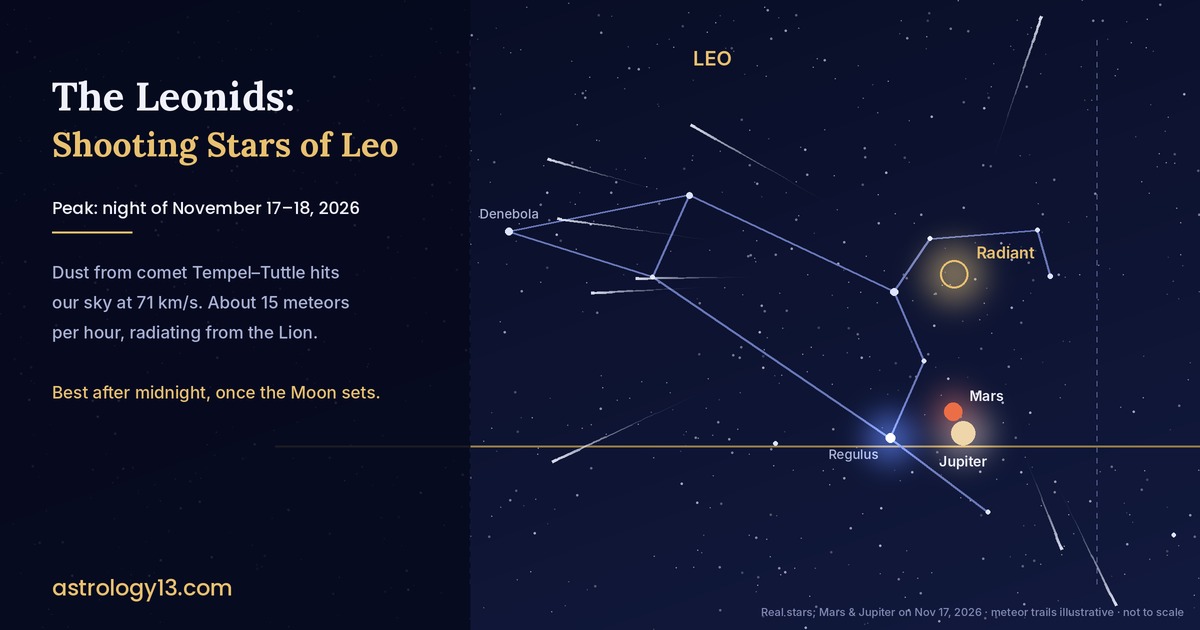
Every November, the sky offers a small celebration for anyone willing to stay up late. The Leonid meteor shower is active from early to late November, and in 2026 it reaches its peak on the night of Tuesday, November 17, into the early hours of Wednesday, November 18. The meteors seem to fly out of the constellation Leo, the Lion, and this year they share that part of the sky with Mars, Jupiter and Regulus.
What is happening in the sky
The Leonids come from comet 55P/Tempel–Tuttle, which orbits the Sun about once every 33 years. Each time it passes close to the Sun, it sheds dust and tiny grains along its path. Every November, the Earth crosses this stream of debris, and the grains enter our atmosphere at about 71 kilometres per second, making the Leonids the fastest of the major meteor showers. Many leave bright, quick streaks, and some leave glowing trails that last a few seconds.
All the meteors seem to come from one point in the sky, called the radiant, inside the "Sickle" of Leo, the backward question mark that forms the Lion's head and mane. This is a perspective effect: like snowflakes in a car's headlights, parallel paths appear to spread out from a single point.
From storms to a gentle shower
The Leonids are famous for their storms. In 1833 and again in 1966, observers saw tens of thousands of meteors per hour, and the 1833 display helped give birth to the scientific study of meteors. Strong displays returned between 1999 and 2002. In a normal year like 2026, expect about 15 meteors per hour under a dark sky. The comet returns to the inner solar system in 2031, so astronomers will be watching the coming years closely.
How to see it
From Athens, the radiant rises in the east-northeast at about 23:30. The first-quarter Moon sets at about 00:10, leaving the rest of the night dark. The best hours are from about 02:00 until the first light of dawn, when Leo climbs high in the east: by 04:00 the radiant is about 50 degrees above the horizon. Find a dark spot away from city lights, lie back, let your eyes adapt for twenty minutes, and look at the wide sky rather than at the radiant itself. As a bonus, you will see Mars and Jupiter shining side by side just below the Sickle, next to Regulus.
The 13-sign view
In 13-sign astrology, the Leonids belong to Leo, the constellation the Sun crosses from August 11 to September 16. In Greek myth, Leo is the Nemean Lion, whose skin no weapon could pierce, defeated by Heracles as the first of his twelve labors. It is a fitting home for a shower of fast and fiery meteors. As we explain in Astrology of the 13 Signs of the Zodiac, the real sky is full of moments like this, connecting old stories with what we can still see tonight.
Not sure which constellation the Sun was in when you were born? Find your true zodiac sign, and then go outside on the night of November 17 to look for shooting stars from the Lion.
Vasilis Kanatas, Delphi, November 2026