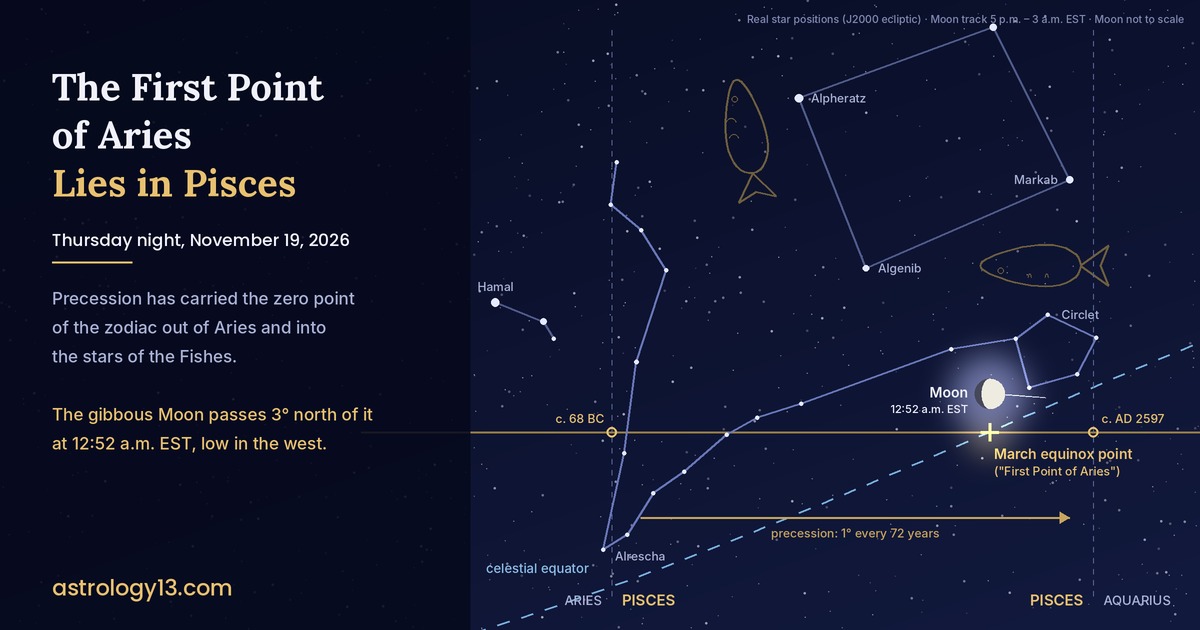
Every map of the sky has a zero. Longitudes on Earth start at Greenwich; longitudes in the sky start at the March equinox point, the spot where the Sun crosses the celestial equator heading north each spring. Astronomers still call it the First Point of Aries. Tonight, Thursday, November 19, the waxing gibbous Moon passes right over it, and the Moon is standing in the stars of Pisces, not Aries.
What is happening
The Moon enters the constellation Pisces at 10:16 a.m. EST and moves about half a degree, its own width, every hour. At 12:52 a.m. EST on Friday, November 20, it reaches the longitude of the equinox point, passing about three degrees to the north of it, roughly six Moon-widths. No star marks this invisible crossroads, so a bright, three-quarters-lit Moon is the best signpost you will get all month.
Why does the "First Point of Aries" sit in Pisces? Earth's axis wobbles like a slowing top, tracing a circle every 25,800 years. As it turns, the equinox point slides westward along the zodiac by about one degree every 72 years. When Greek astronomers named it, roughly 2,100 years ago, the point lay at the edge of Aries. Using the modern constellation boundaries, it crossed into Pisces around 68 BC, and it will not reach Aquarius until about AD 2597. The name stayed; the sky moved on.
How to see it from New York
The Moon rises in the east around 1:35 p.m. and stands highest in the south at about 8 p.m., some fifty degrees up. As the evening goes on it sinks toward the west; at the moment of the crossing it is about thirteen degrees above the western horizon, so find an open view in that direction. Without the Moon, you can still locate the point: take the two eastern stars of the Great Square of Pegasus, Alpheratz and Algenib, and extend the line between them southward by the same distance again. You land close to the place where every spring officially begins.
The 13-sign view
Because of this slow drift, the Sun now spends the March equinox among the stars of Pisces (March 12 – April 18), about eight days after entering the constellation. Many people born in late March read "Aries" in their horoscope, yet the Sun was shining in the Fishes when they were born. The true Aries (April 19 – May 13) begins a full month later. This is exactly why the real sky has thirteen constellations along the Sun's path, and why the dates differ so much from the familiar twelve, a story I explore in detail in my book, Astrology of the 13 Signs of the Zodiac.
Tonight, step outside, find the Moon, and picture the invisible line crossing beneath it. You are looking at the zero point of the whole zodiac, quietly resting in Pisces. Curious where the Sun really stood on your birthday? Find your true sign here.
Vasilis Kanatas, Delphi