The 13-sign view
Most horoscope columns will tell you that this full Moon falls in Gemini, with the Sun in Sagittarius. Those labels come from the tropical zodiac, fixed to the seasons almost 2,000 years ago. Because of the slow wobble of Earth's axis, called precession, the real constellations have shifted by nearly a whole sign since then. Look up and you will see the truth: the Moon sits in Taurus (May 14 – June 20) and the Sun in Scorpio (November 23 – November 29), the shortest solar visit of the year, before it moves into Ophiuchus (November 30 – December 17) on November 30.
For people born under Taurus, this is a full Moon in their own constellation, a natural moment to harvest what they have patiently grown since spring. For those born in Scorpio's brief week, it marks the start of their season with the brightest possible mirror held up opposite them. My book, Astrology of the 13 Signs of the Zodiac, explains how these real positions change the familiar picture.
Curious whether your own Sun was in a different constellation than you thought? Find your true zodiac sign, then step outside on Monday night and greet the Beaver Moon among the stars of the Bull.
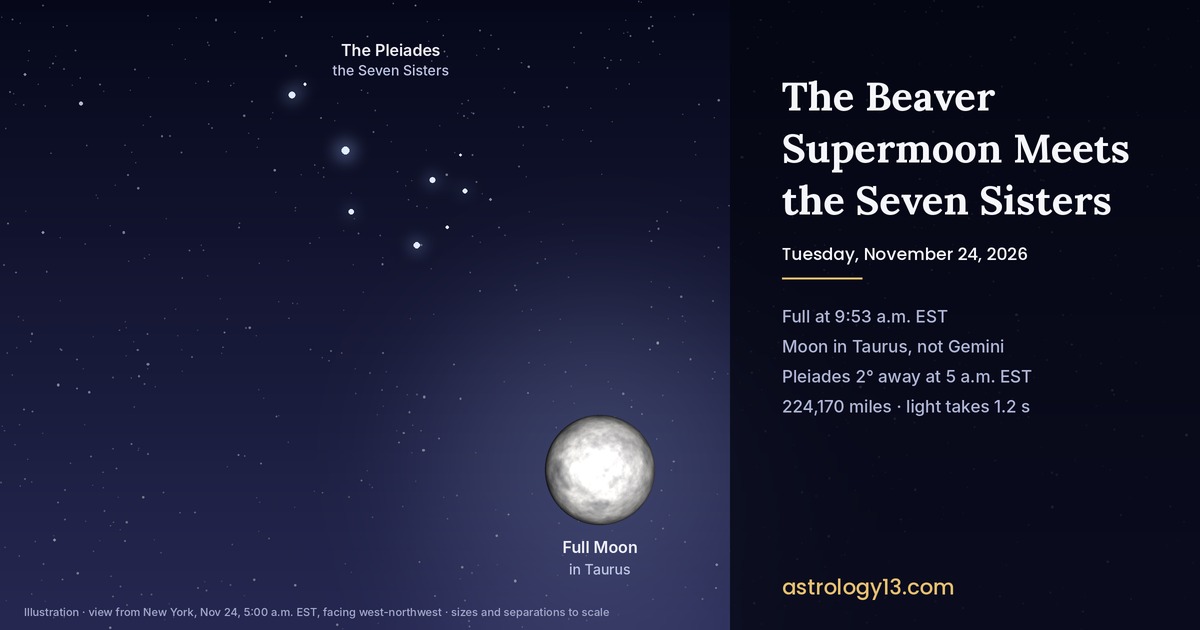
On Tuesday, November 24, the Moon becomes full at 9:53 a.m. EST, and for once the calendar and the sky offer a double gift. November's Beaver Moon is also a supermoon, and it shines among the stars of Taurus, a few degrees from the Seven Sisters of the Pleiades. Here is what is happening, how to see it from New York and the rest of the USA, and why the 13-sign zodiac tells a different story from the newspaper horoscope.
What is happening in the sky
At the moment of fullness the Moon will be about 224,170 miles (360,768 km) from Earth, or 0.0024 AU. Its light reaches us in just 1.2 seconds. Perigee, the closest point of this orbit, follows a day later, on November 25. Because a full Moon and a near-perigee Moon coincide, the disk looks slightly larger and brighter than an average full Moon. The difference is real but subtle: you are more likely to notice the extra brightness than the size.
The full Moon always sits opposite the Sun. On Tuesday the Sun stands inside Scorpio, which it entered on Monday at 12:30 p.m. EST, so the Moon lies directly across the sky in Taurus. The two ancient guardians of this axis, red Antares in the Scorpion and orange Aldebaran in the Bull, face each other across the heavens, and the Moon now takes Aldebaran's side.
How to see it from New York
Monday evening, November 23: the 99-percent-lit Moon rises at 3:33 p.m. EST in the east-northeast. As darkness falls, the small, misty cluster of the Pleiades shines about seven degrees to its lower left.
Tuesday before dawn, November 24: this is the prettiest view. Around 5 a.m. the Moon hangs low in the west-northwest, roughly 19 degrees above the horizon, with the Pleiades only about two degrees to its upper left. By 6 a.m. the gap shrinks to about one and a half degrees as the pair sinks into twilight. The Moon sets at 6:59 a.m. Binoculars help, because moonlight easily drowns the fainter Sisters.
Tuesday evening, November 24: the full Moon rises at 4:21 p.m. EST, now east of the cluster. By 6 p.m. the Pleiades glitter about eight degrees to its upper right, and Aldebaran glows about ten degrees to its lower right, completing a lovely triangle.
Vasilis Kanatas, Delphi