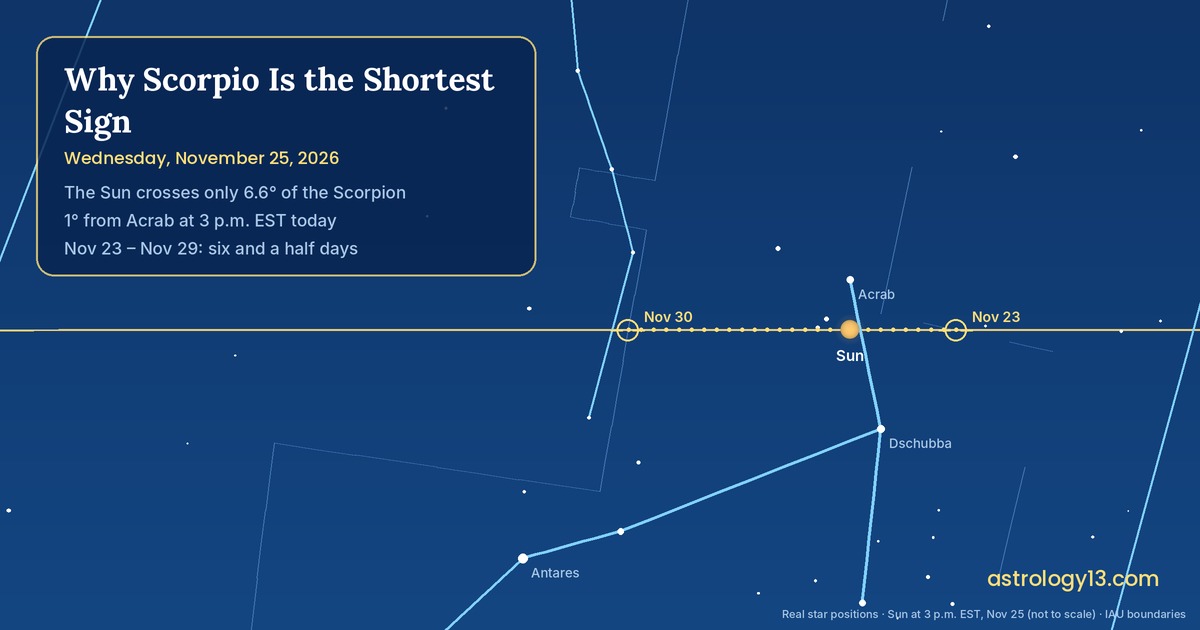
Today, Wednesday, November 25, the Sun passes between two stars that form the forehead of the Scorpion. It slips 2 degrees north of Dschubba at 12:24 a.m. EST and about 1 degree south of Acrab around 3 p.m. EST, its closest pass to any bright star of the constellation this year. It is also the midpoint of the shortest solar season in the sky. Why does the Scorpion keep the Sun for less than a week?
What is happening in the sky
The Sun entered Scorpius on Monday, November 23, at 12:30 p.m. EST, and it leaves for Ophiuchus at 12:40 a.m. EST on Monday, November 30. In between it crosses just 6.6 degrees of the ecliptic, the yearly path of the Sun, from longitude 241.1 to 247.7 degrees. Moving about one degree a day, it needs only six and a half days. For comparison, Virgo holds the Sun for about 44 days.
Acrab, today's neighbor, is not a single star at all. Telescopes split it into a whole family of suns orbiting one another, so this afternoon our Sun visits a stellar household rather than a lone lamp.
Why the Scorpion gets only a week
Scorpius is a large and brilliant constellation, but most of it lies south of the ecliptic. The Sun's road clips only its northern edge, the head and the base of the claws. In 1930 the International Astronomical Union adopted official boundaries for all 88 constellations, drawn by the Belgian astronomer Eugène Delporte along lines of right ascension and declination. Those straight lines let the feet of Ophiuchus, the Serpent Bearer, reach down across the ecliptic, and they give him about 18.6 degrees of the Sun's path, nearly three times the Scorpion's share.
Here is the surprise: Antares, the red heart of the Scorpion, sits 4.6 degrees south of the ecliptic, and the Sun passes it on December 2, when it is already inside Ophiuchus. The heart of the Scorpion shines during the Serpent Bearer's season.
The ancient Scorpion was even larger. The Greeks counted the stars of today's Libra as its claws, and only later did those claws become the Scales.
How to see it
You cannot see stars around the Sun in daylight, and you should never look at the Sun directly. From New York the Sun sets at 4:32 p.m. EST today in the southwest, taking the hidden head of the Scorpion down with it. Acrab and Dschubba will return to the dawn sky in late December, low in the southeast before sunrise, a few weeks after the Sun has moved on.
The 13-sign view
In the 13-sign zodiac, Scorpio (November 23 – November 29) is the rarest birthday sign: only seven calendar days a year. Most of its people were told they were Sagittarians, and their character shows it: outgoing, generous with opinions, rebels with good manners. Before them comes Libra (October 31 – November 22); after them, Ophiuchus (November 30 – December 17), followed by Sagittarius (December 18 – January 19).
If you were born this week, you belong to the smallest club in the sky. In Astrology of the 13 Signs of the Zodiac I give the real dates of every sign, year by year. To check your own, use Find Your True Zodiac Sign.
Love the constellations? Win one of 100 Kindle copies of Star Maps, Myths and Exoplanets in my Goodreads Giveaway, open to readers in the USA until December 24.
Vasilis Kanatas, Delphi