On Monday, November 30, at 12:40 a.m. EST, the Sun leaves Scorpio (November 23 – November 29) and enters Ophiuchus, the Serpent Bearer (November 30 – December 17). Yet almost every horoscope you read still lists twelve signs. To understand why, we have to travel back to the clay tablets of Babylon, where the zodiac was born, and ask a simple question: were the twelve signs ever meant to describe the stars exactly?
A calendar, not a census of the stars
The oldest Babylonian star compendium, known by its opening words MUL.APIN, was probably compiled around 1000 BC; its earliest surviving copy dates from 686 BC. It does not list twelve zodiac constellations. It names seventeen or eighteen star groups "in the path of the Moon," including the Pleiades and Orion, the "True Shepherd of Anu," alongside the Bull of Heaven, the Crab, the Lion, the Furrow and the Scorpion.
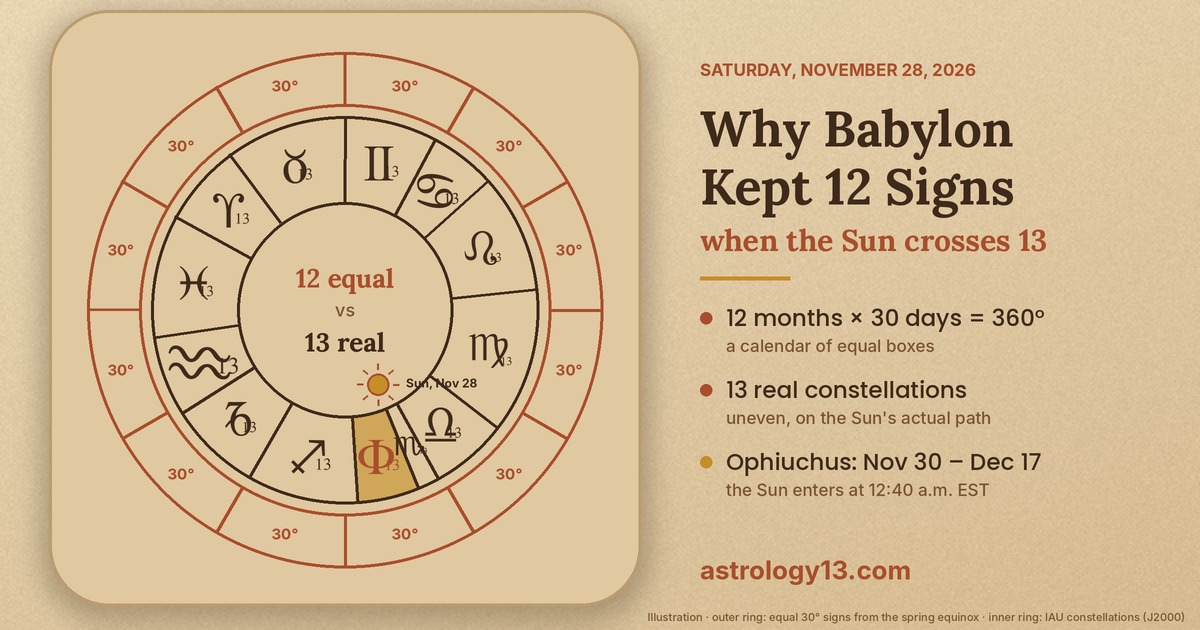
Twelve came later, around the end of the fifth century BC, and for a practical reason. Babylonian astronomers worked with an idealized year of twelve months of thirty days, and they counted in base 60. Dividing the Sun's path into twelve equal parts of 30 degrees fitted that arithmetic perfectly: 12 × 30 = 360. Each "sign" became a coordinate, a tidy box for calculating where the Moon and planets would be. The earliest known horoscope, written in cuneiform in 410 BC, already uses this system.
What the sky actually shows
The stars themselves never agreed to equal boxes. Constellations are uneven shapes, and in 1930 the International Astronomical Union fixed their official borders, drawn by the Belgian astronomer Eugène Delporte. Along those borders the Sun crosses thirteen constellations, not twelve. It spends about 44 days in Virgo (September 17 – October 30), only about seven in Scorpio, and roughly 18 in Ophiuchus, whose foot steps right across the ecliptic between the Scorpion and the Archer, Sagittarius (December 18 – January 19).
There is a second difference: precession. Modern horoscopes, following a Greek convention, start the boxes at the spring equinox, and Earth's slow wobble moves that point about one degree every 72 years. Over the twenty-four centuries since Babylon, the boxes and the stars have drifted apart by more than a full sign.
How to see the Babylonian sky tonight
You cannot see Ophiuchus this week, because it rises and sets with the Sun. But several Babylonian figures are on show over New York on Saturday night. After dark, the Pleiades and the Bull of Heaven climb in the east. At 9:06 p.m. EST the Moon, about three-quarters lit, rises in the east-northeast inside the Crab, with the Beehive star cluster a couple of degrees away, a lovely sight in binoculars. These are the very lights the scribes of Babylon recorded.
The 13-sign view
The Babylonians were not wrong. They built a brilliant calendar, and calendars need equal parts. The 13-sign approach simply asks a different question: where was the Sun really standing, among the real stars, on the day you were born? If your birthday falls between November 30 and December 17, the answer is Ophiuchus.
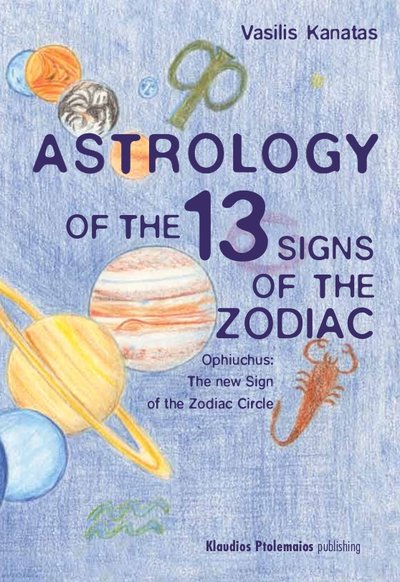
My book, Astrology of the 13 Signs of the Zodiac, gives these real dates year by year. You can also check your own sign in seconds: Find your true zodiac sign.
Vasilis Kanatas, Delphi