Most of us have never knowingly seen Uranus, yet the seventh planet is now at its best for the whole year. On Wednesday, November 25, 2026, Uranus reaches opposition in the constellation Taurus. It rises at sunset, stays up all night and stands highest around one o'clock in the morning. If you have a pair of binoculars, the next few nights are a perfect time to find it.
What is happening in the sky
At opposition, Earth passes between the Sun and Uranus, so the planet lies directly opposite the Sun in our sky. This is when it is closest to us and fully lit. Close is a relative word here: even on November 25, Uranus is 18.4 astronomical units from Earth, about 2.76 billion kilometres. Its reflected sunlight needs about 2 hours and 33 minutes to reach your eyes, so you see the planet as it was well before you stepped outside.
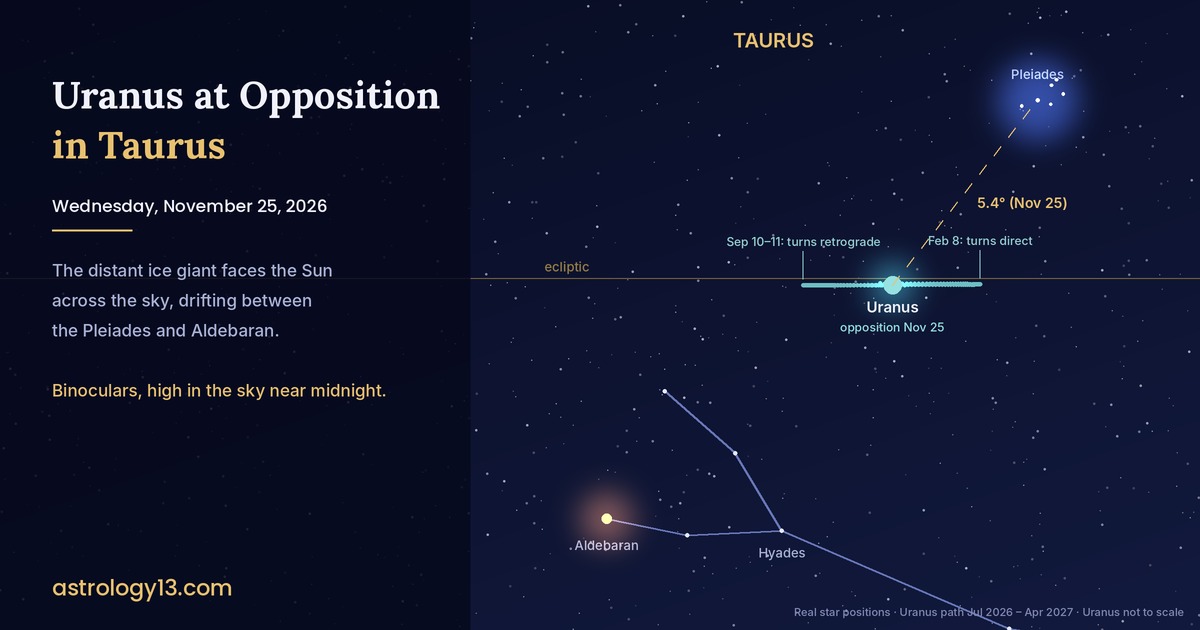
Since September 10–11, Uranus has been moving backward (retrograde) against the stars, and it will keep doing so until February 8, 2027. The planet is not really reversing. Our faster Earth, which needs one year for an orbit, is simply overtaking a world that needs 84 years for one lap around the Sun. Seen from the moving Earth, the slow outer planet seems to drift west for a few months.
How to see it
Uranus shines at magnitude 5.6, right at the limit of the naked eye under a truly dark sky, and easy in binoculars. It is a tiny blue-green point that does not twinkle as much as the stars around it.
The finder is simple. Locate the Pleiades, the small misty cluster high in the east in the evening, and then the orange star Aldebaran below and to its left. Uranus sits on the line between them, about 5.6 degrees southeast of the Pleiades, roughly ten full-Moon widths away.
From Athens on November 15, Uranus rises at about 17:45 in the east-northeast and is already 50 degrees high by 22:00. It reaches 73 degrees, almost overhead in the south, at about 00:50. The Moon is the main obstacle: tonight the crescent sets at about 22:10, tomorrow at about 23:10, and later each night after that. On November 24 the Full Moon itself shines in Taurus, about 5 degrees from Uranus, so the best nights are this week, after moonset.
The 13-sign view
In the tropical zodiac the planet is already counted in Gemini, but in the real sky Uranus is in the constellation Taurus, where the Sun shines from May 14 to June 20. The planet entered the Bull in March 2025 and will stay until mid-2033, a long visit that gives the Taurus constellation an inventive, restless accent. It is a reminder that every planet travels through the stars of the real zodiac, including Ophiuchus (November 30 – December 17), at its own pace. In Astrology of the 13 Signs of the Zodiac, these real positions are the starting point for every interpretation.
Fittingly, William Herschel discovered Uranus in 1781 very close to this part of the sky, near the border of Taurus and Gemini. Nearly three 84-year laps later, it is approaching that same spot again.
Curious about where the Sun really stood on your birthday? Find your true zodiac sign here and see which of the 13 constellations is truly yours.
Vasilis Kanatas, Delphi, Nvember 2026