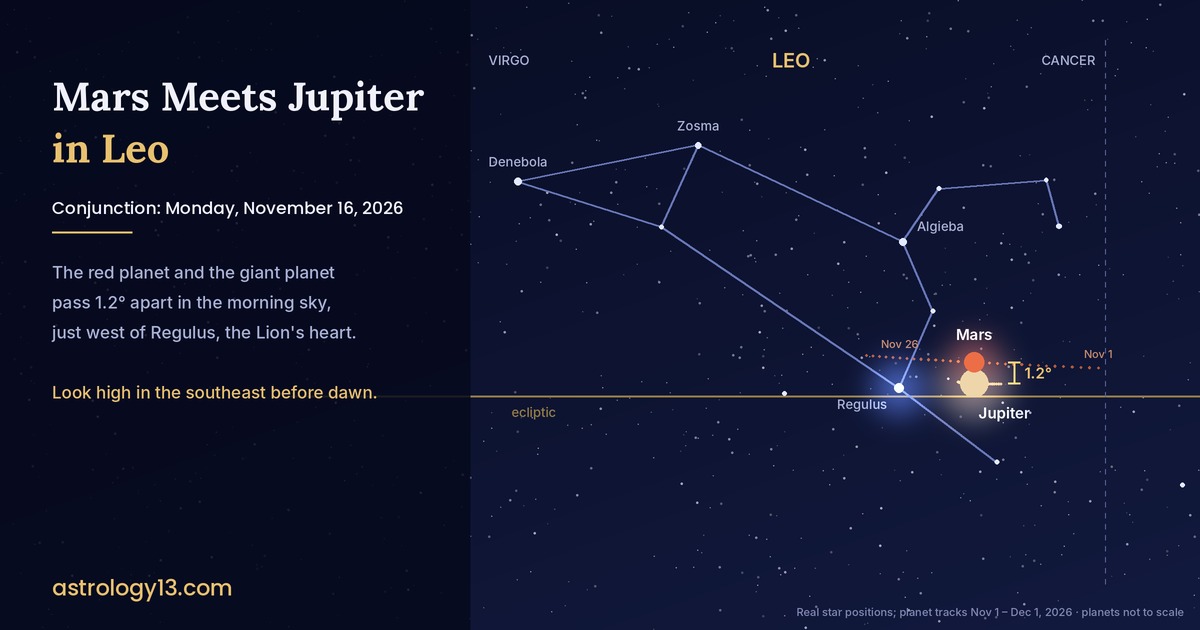
Mars Meets Jupiter in Leo: A Royal Conjunction Before Dawn
Set your alarm a little earlier this week. High in the predawn sky, two of the brightest planets are drifting toward each other among the stars of Leo, the Lion. On the morning of Monday, November 16, 2026, Mars catches up with Jupiter, and the pair pass about 1.2 degrees apart, roughly the width of two and a half full Moons. Just beside them shines Regulus, the Lion's heart, completing one of the loveliest planetary scenes of the autumn.
What is happening in the sky
Mars is much closer to us than Jupiter, so it moves faster against the background stars. Through October and November the red planet has been closing the gap morning after morning, and by November 12 the two are already less than two degrees apart. After the conjunction, Mars pulls ahead toward the east, and on November 26 it passes less than two degrees from Regulus itself. At the end of the month, around November 30 and December 1, the waning Moon joins the group, creating a beautiful gathering of Moon, Jupiter, Mars and Regulus.
The "meeting" is a line-of-sight effect. On November 16, Mars is about 1.3 astronomical units from Earth, while Jupiter is about 5.3, four times farther away. Light from Mars reaches us in about 11 minutes; light from Jupiter needs about 44. The two planets are nowhere near each other in space. From our viewpoint they simply line up in the same direction, against the stars of Leo.
How to see it
Leo climbs above the eastern horizon after midnight. By 5:30–6:00 a.m. Greek time, the pair stands high in the southeast. Jupiter is the brighter one, a steady cream-white light. Mars is fainter and clearly orange, sitting right beside it. No equipment is needed, but binoculars will show both planets in the same field of view, and a small telescope reveals Jupiter's four large moons. Lower in the east before sunrise you can also spot brilliant Venus near Spica in Virgo.
Read more: Mars Meets Jupiter in Leo: A Royal Conjunction Before Dawn
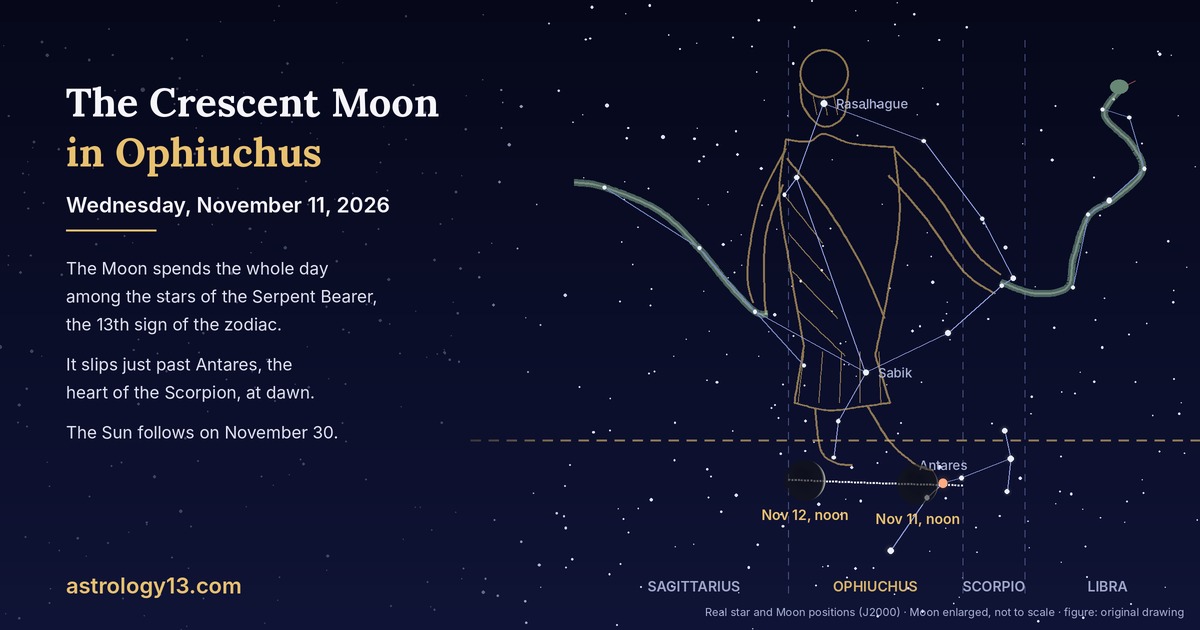
The Crescent Moon Crosses Ophiuchus: A Monthly Visit to the 13th Sign
On Wednesday, November 11, 2026, a slender crescent Moon, just two days after the New Moon of November 9, spends the entire day among the stars of Ophiuchus, the Serpent Bearer. It is a perfect reminder that the 13th sign is not a theory: it is a real stretch of sky that the Moon, the Sun and the planets cross again and again.
The Moon's monthly visit to the 13th sign
The Moon circles the zodiac in about 27.3 days, moving roughly 13 degrees a day against the background stars. So every month it passes through all 13 zodiac constellations, Ophiuchus included. This time it enters the Serpent Bearer at about 02:30 Greek time on November 11 and moves on to Sagittarius (December 18 – January 19) around 15:40 on November 12. Along the ecliptic, Ophiuchus spans almost 19 degrees, nearly three times the width of its neighbour Scorpio (November 23 – November 29), the shortest sign of all.
Read more: The Crescent Moon Crosses Ophiuchus: A Monthly Visit to the 13th Sign
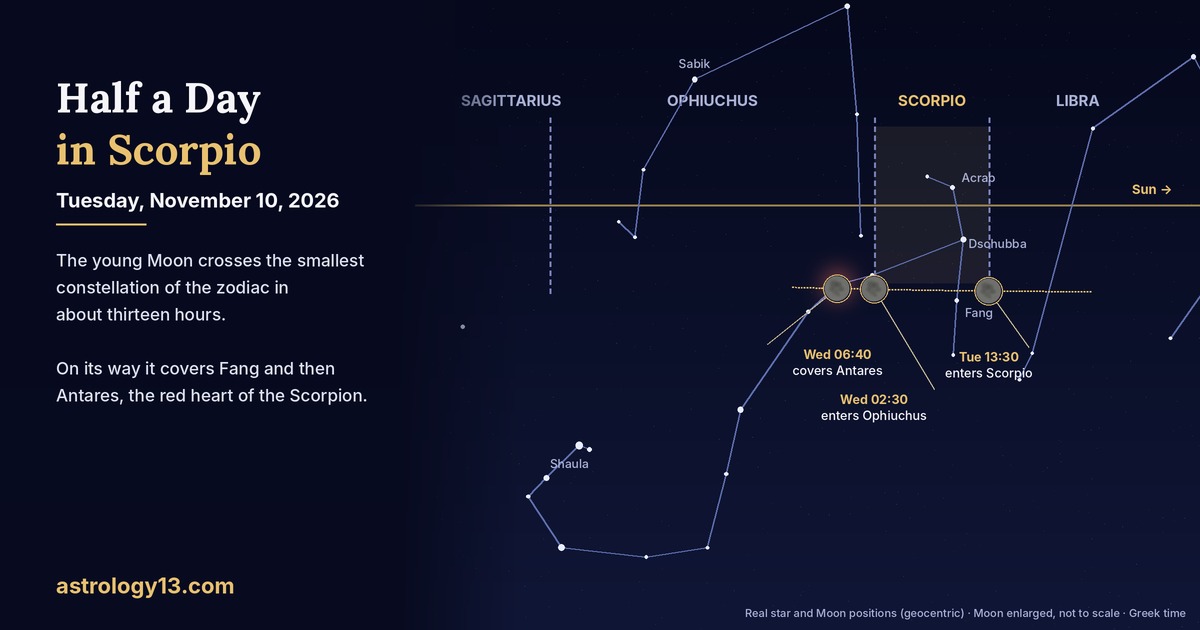
Scorpio, the Shortest Sign: The Moon Crosses the Scorpion in Thirteen Hours
On Tuesday, November 10, 2026, the young Moon does something it does every month, though hardly anyone notices. It crosses the whole of Scorpio (November 23 – November 29) in about thirteen hours. The Moon enters the stars of the Scorpion at 11:28 UT (13:28 Greek time) and moves on into Ophiuchus (November 30 – December 17) at about 00:28 UT on Wednesday (02:28 Greek time). No other part of the zodiac goes by so quickly.
Only a corner of the Scorpion
Scorpius is a long curve of bright stars ending in a raised stinger, yet the ecliptic, the path the Sun follows through the year, only clips its northwestern corner, near the head stars Acrab and Dschubba. Measured along that path, the constellation's official boundaries, drawn by the International Astronomical Union in 1930, cover only about 6.6 degrees. After that, the Sun's road runs through Ophiuchus, the Serpent Bearer, for more than 18 degrees.
The rest of the Scorpion lies well to the south. Even Antares, the Scorpion's red heart, lies a little east of the point where the ecliptic leaves Scorpius, just below the stretch of the Sun's path that belongs to Ophiuchus.
Read more: Scorpio, the Shortest Sign: The Moon Crosses the Scorpion in Thirteen Hours
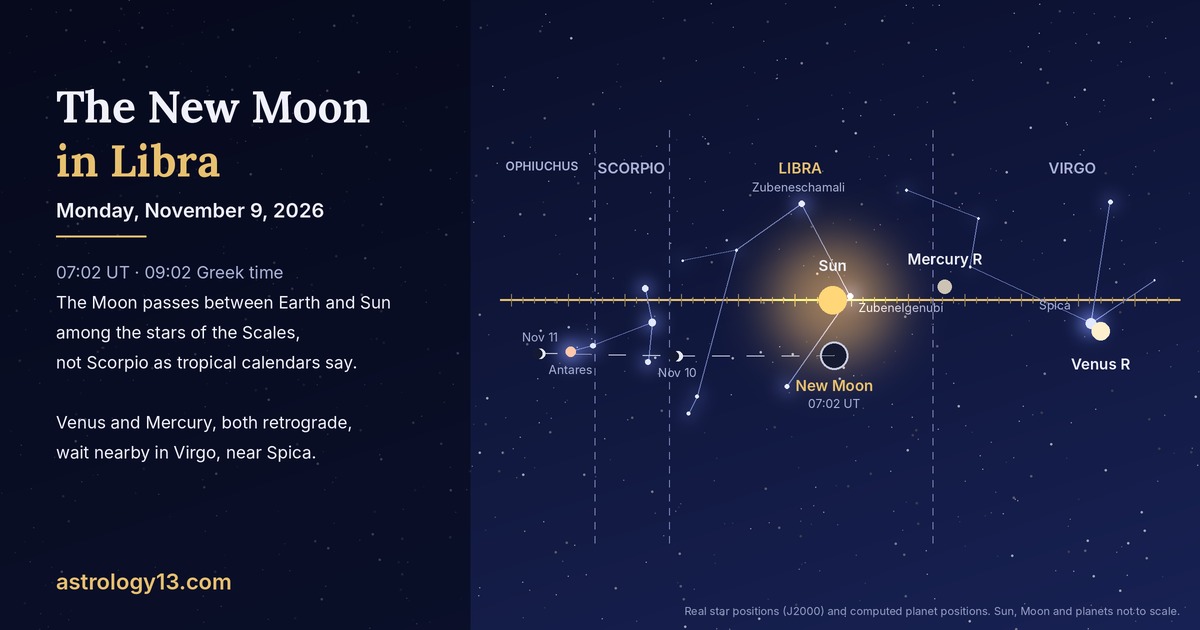
The New Moon in Libra: A Fresh Start Under the Scales
On Monday, November 9, 2026, at 07:02 UT (09:02 Greek time), the Moon reaches its new phase. For a few hours it lines up between the Earth and the Sun and disappears completely from view. Many horoscopes will call this a "New Moon in Scorpio". Look at the real sky, though, and you will find the Sun and the Moon together in front of the stars of Libra.
What happens at a New Moon
The Moon is always half lit by the Sun. What changes from night to night is how much of that sunlit half we can see from Earth. At New Moon the Moon stands on the same side of the Earth as the Sun, so its bright face points away from us and its dark side faces us. It rises and sets with the Sun, hidden in daylight.
From one New Moon to the next takes about 29.5 days, the synodic month. Within a day or two after Monday, a slender crescent will appear low in the southwest just after sunset. Each evening it will grow a little thicker and climb a little higher, until the next Full Moon on November 24.
Read more: The New Moon in Libra: A Fresh Start Under the Scales
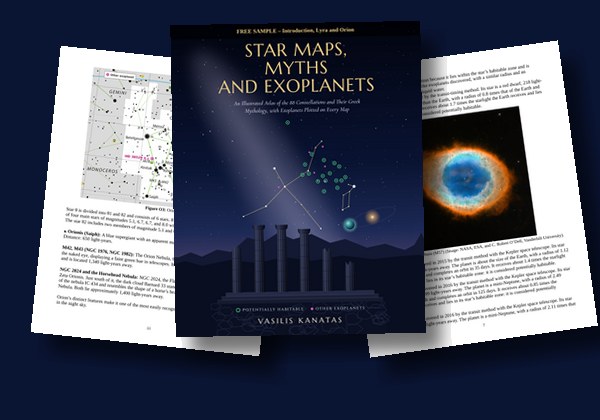
Star Maps, Myths and Exoplanets – My New Book
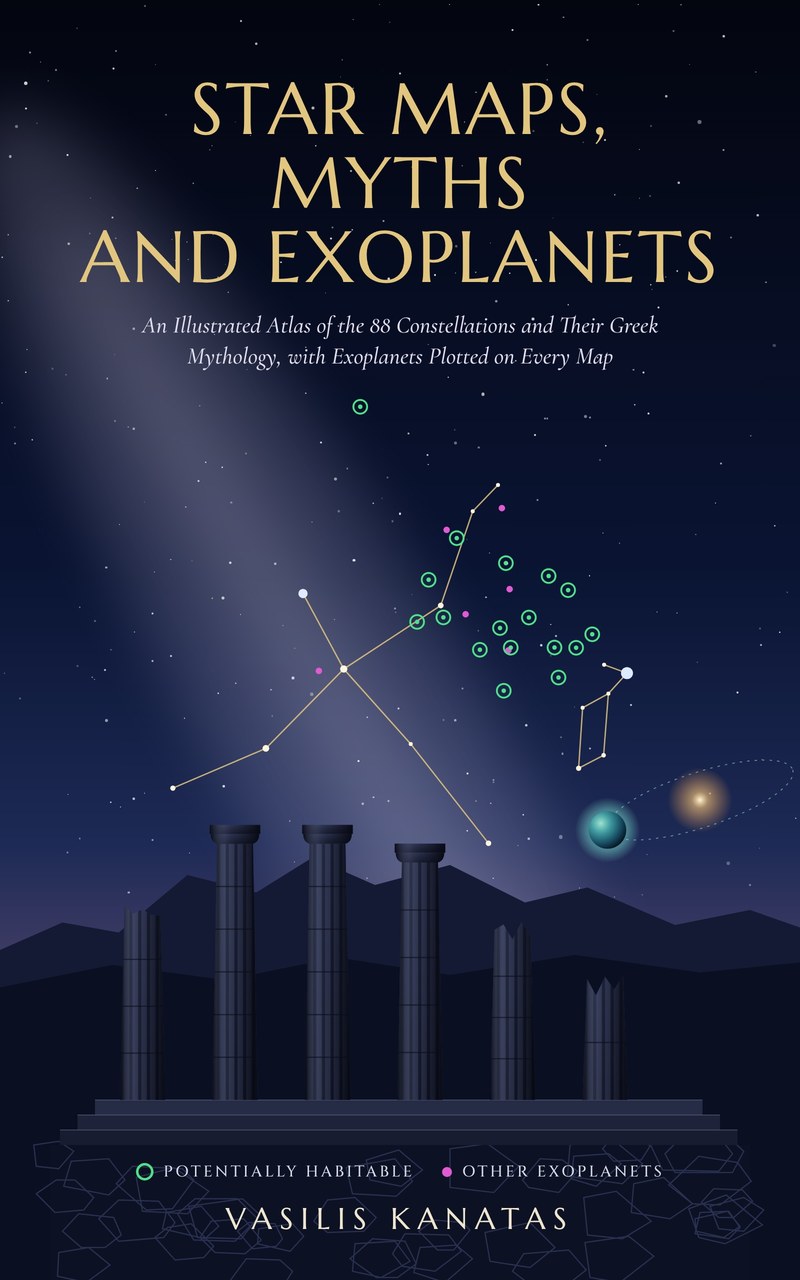
Look up at the night sky and you can read two stories at once: the myths the ancient Greeks wrote among the stars, and the new worlds astronomers have found circling those same stars. My new book, Star Maps, Myths and Exoplanets, brings the two together for the first time in a single atlas.
Paperback in full colour – $29.99 Kindle eBook – $9.99 or free with Kindle+
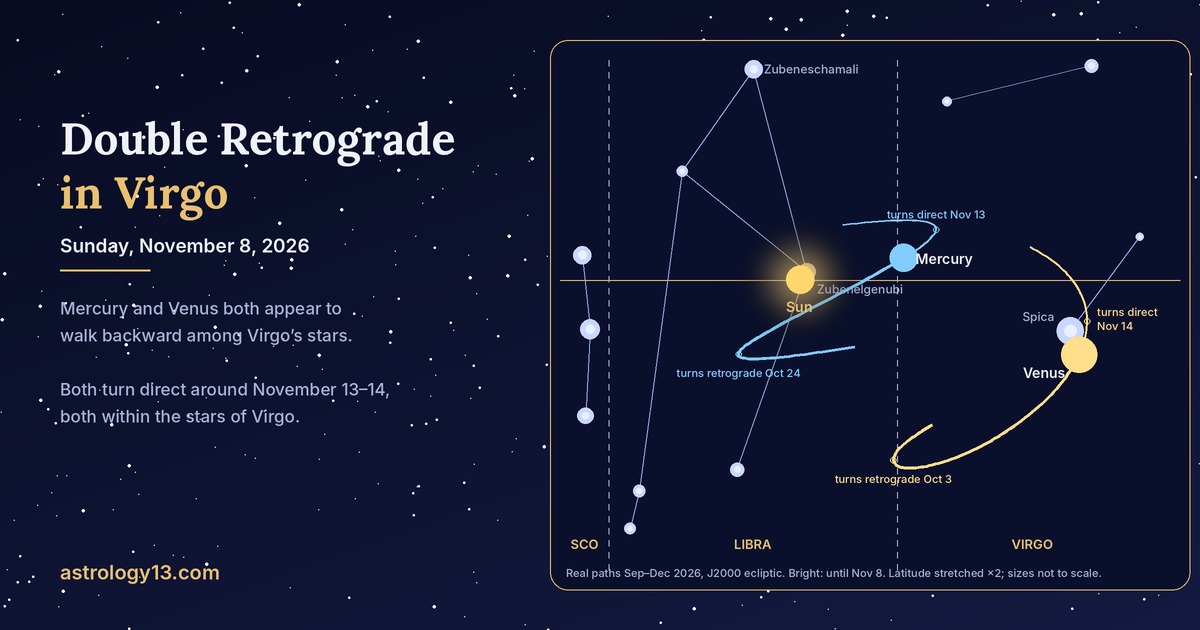
Double Retrograde in Virgo: Why Mercury and Venus Seem to Walk Backward
For a few days this November, two of our closest neighbours are doing something that has fascinated sky-watchers for thousands of years. Both Mercury and Venus appear to move backward against the stars, and in the real sky they are doing it in the same constellation: Virgo.
What retrograde motion really is
No planet ever stops or reverses in its orbit. Retrograde motion is an effect of perspective. Mercury and Venus orbit the Sun inside Earth's orbit and move faster than we do. When one of them passes between the Earth and the Sun, an alignment called inferior conjunction, it overtakes us on the "inside lane". For a few weeks around that moment, its position against the distant stars appears to slide westward instead of eastward.
Venus reached inferior conjunction around October 23–24, 2026, and Mercury on November 4. That is why both are retrograde at the same time. Venus has been moving backward since October 3, and Mercury since October 24. Both turn direct again around November 13–14, 2026.
Read more: Double Retrograde in Virgo: Why Mercury and Venus Seem to Walk Backward
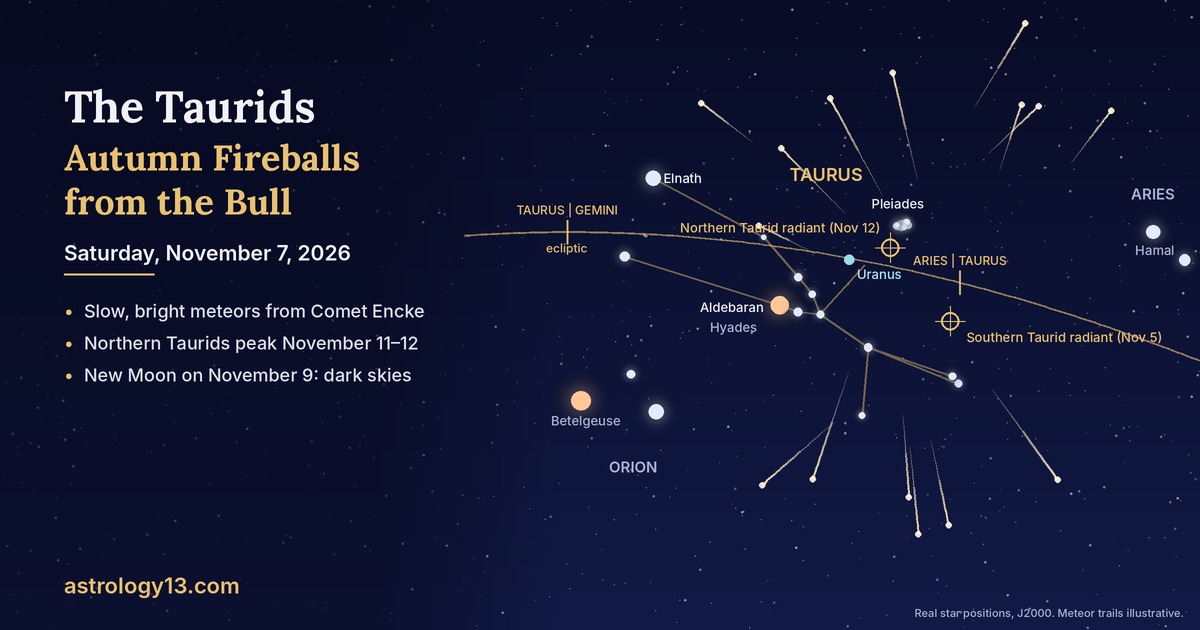
The Taurids: Autumn Fireballs from the Bull (Taurus)
If you are outdoors on a dark November night and see a slow, bright meteor gliding across the sky, there is a good chance it is a Taurid. This modest but much-loved meteor shower is active right now, and 2026 offers it a gift: a New Moon on November 9, just before the Northern Taurids reach their peak.
Two Showers from One Comet
The Taurids are really two streams of debris. The Southern Taurids are active from about September 20 to November 20 and peaked around November 4–5. The Northern Taurids run from about October 20 to December 10 and peak on the nights of November 11–12. Both come mainly from Comet 2P/Encke, which has one of the shortest orbits of any known comet, returning to the Sun every 3.3 years. Over thousands of years it has scattered a wide trail of dust and pebbles along its path, and the Earth crosses that trail every autumn.
Read more: The Taurids: Autumn Fireballs from the Bull (Taurus)
Page 2 of 6